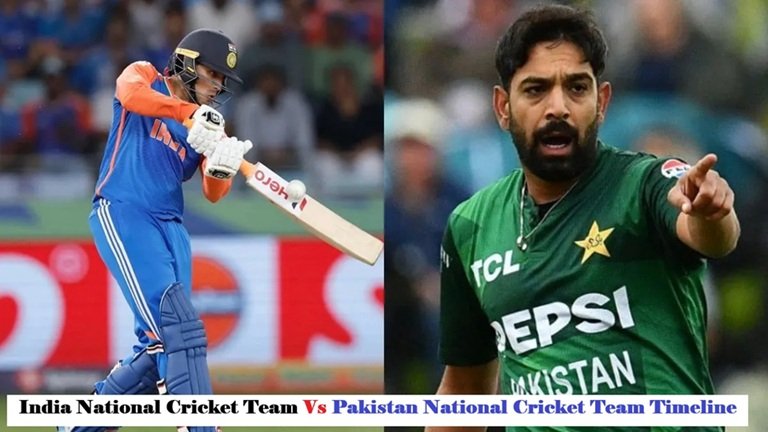

The India national cricket team vs Pakistan national cricket team timeline is one of the maximum severe rivalries in global sports. Since their first meeting in 1952, each contest — whether in Tests, ODIs, or T20Is — has been filled with emotions, history, and political undertones. The competition has produced unforgettable moments, legendary performances, and cultural significance beyond the boundary line.
Head-to-Head Statistics
| Format | Matches | India Wins | Pakistan Wins | Draw / NR |
|---|---|---|---|---|
| Test | 59 | 9 | 12 | 38 |
| ODI | 136 | 58 | 73 | 5 |
| T20I | 12 | 8 | 3 | 1 |
| ICC World Cup (ODI) | 8 | 8 | 0 | 0 |
| T20 World Cup | 7 | 5 | 1 | 1 |
| Champions Trophy | 5 | 2 | 3 | 0 |
Major ICC Matches – Timeline Table
| Year | Tournament | Venue | Winner | Key Highlights |
|---|---|---|---|---|
| 1992 | ODI World Cup | Sydney | India | India beat Pakistan in group stage |
| 1996 | ODI World Cup | Bangalore | India | Quarter-final, high-voltage match |
| 2003 | ODI World Cup | Centurion | India | Tendulkar’s iconic 98 |
| 2007 | T20 World Cup Final | Johannesburg | India | Last-over thriller won by India |
| 2011 | ODI World Cup Semi-final | Mohali | India | India beat Pakistan in the group stage |
| 2014 | Asia Cup | Dhaka | Pakistan | Afridi last-over sixes |
| 2017 | Champions Trophy Final | London | Pakistan | Pakistan wins by 180 runs |
| 2021 | T20 World Cup | Dubai | Pakistan | Pakistan wins by 10 wickets |
| 2022 | T20 World Cup | Melbourne | India | Kohli’s legendary 82* |
| 2023 | Asia Cup | Colombo | India | India wins by record margin |
| 2024 | T20 World Cup | New York | India | Low-scoring thriller |
| 2025 | Champions Trophy | Dubai | India | India reaches the final |
Bilateral Series Highlights Table (1952–2007)
| Year | Host | Format | Result | Notable Moments |
|---|---|---|---|---|
| 1952–53 | India | Test Series | India 2–1 | First-ever IND vs PAK Test |
| 1954–55 | Pakistan | Test Series | 0–0 Draw | All 5 Tests drawn |
| 1978–79 | Pakistan | Test & ODI | Pakistan dominated | Kapil Dev debut |
| 1986–87 | India | Test Series | Pakistan 1–0 | Miandad’s last-ball six (Sharjah) |
| 1999 | India | Test Series | Pakistan 2–1 | Chennai 1999 classic |
| 2004 | Pakistan | Full Tour | India wins ODI series | Sehwag’s 309 at Multan |
| 2005–06 | Pakistan | Full Tour | Drawn Tests | Kapil Dev’s debut |
| 2006 | India | ODI Series | India 4–1 | Dhoni & Pathan heroics |
Origins of the Rivalry (50)
The rivalry officially began in October 1952, whilst India hosted Pakistan for their first-ever Test series. India received the inaugural suit in Delhi by way of an innings and 70 runs. Soon after, Pakistan hosted India in 1954–55, resulting in an unprecedented five-fit Test collection where ALL matches resulted in a draw — something precise in cricket history.
These early years laid the bottom for what might end up as cricket’s maximum emotionally charged contention.
The 1970 and 80s – Rivalry Intensifies
The period between 1978 and 1987 is remembered for near contests, private battles, and the emergence of superstars.
Notable moments:
- 1978 Shahid Afridi’s early spark (relying on technology, but star moments came later)
- India’s 1983 World Cup win raised self-assurance levels.
- 1986 Sharjah Final: Miandad’s remaining-ball six, one of the maximum iconic moments in cricket records.
This era permanently accelerated the contention.
1990 – World Cup Drama Begins
The Nineties added the rivalry on the worldwide level via the World Cups.
Key Matches:
- 1992 World Cup – India wins at Sydney.
- 1996 World Cup – India knocks Pakistan out in the sector-very last.
- 1999 Chennai Test – Pakistan’s exciting 12-run win; Pakistan’s Wasim Akram’s brilliance.
- 1999 World Cup – India wins once more, retaining WC dominance.
2000s – Cricketing Peaks and Political Tensions
This era produced contemporary greats like Tendulkar, Dravid, Sehwag, Younis Khan, Inzamam, and Shoaib Akhtar.
Iconic moments:
- 2003 World Cup – Sachin’s unforgettable 98 towards Pakistan.
- 2004 Pakistan Tour – India’s first series win in Pakistan.
- 2007 T20 World Cup – India wins the inaugural, very last vs Pakistan.
However, after 2008, political tensions forced bilateral cricket into a near-freeze.
2010s–2020s – ICC-Only Rivalry
Since bilateral cricket matches have been largely halted, India–Pakistan suits have occurred in ICC tournaments and Asia Cups.
Major Highlights:
- 2011 World Cup Semi-very last – India wins in front of the PMs of both countries.
- 2017 Champions Trophy Final – Pakistan’s 180-run domination.
- 2021 T20 World Cup – Pakistan’s ancient 10-wicket win.
- 2022 T20 World Cup – Virat Kohli’s miracle chase in Melbourne.
Every stumble upon brings massive viewership — often breaking international sports records.
Political & Social Influence on the Rivalry
The rivalry reflects:
- Partition history
- Border conflicts
- Diplomatic tensions
- National pleasure and cultural emotion
Because of this:
- Neutral venues are favoured
- Security worries prevent excursions
- ICC tournaments turn out to be the handiest assembly floor
Yet, the passion stays unmatched.
Why the India-Pakistan Rivalry Matters
- Massive Global Viewership
- Cultural & Emotional Significance
- Legendary Performances
- Historic Narrative
- One of the top three rivalries in ANY sport
Future of India vs Pakistan Cricket
- Bilateral series may additionally go back if political conditions improve.
- Young stars (Gill, Bumrah, Babar, Shaheen) will shape the following era.
- ICC will keep the usage of this contention as a primary global enchantment.
FAQs
1. When did India and Pakistan first play cricket?
In 1952, in a Test series in India.
2. Why don’t India and Pakistan play bilateral cricket?
Due to political tensions and security issues.
3. Who has the higher typical report?
Pakistan leads in ODIs and Tests, even as India dominates T20Is and ICC activities.
4. What is the most iconic match?
Many debates, however well-known, consist of:
- 1986 Sharjah Final (Miandad’s 6)
- 2003 World Cup (Tendulkar 98)
- 2007 T20 Final
- 2022 T20 WC (Kohli’s 82*)
5. Why is India vs Pakistan so emotional?
Because of history, politics, shared culture, and country-wide pride.
Read More:-